
Friday, February 8, 2013


Monday, December 3, 2012
Cover Story: King's Raven by Maggie Secara
Labels:
Art,
Artsy Fartsy,
Design,
What I'm Working On,
when I'm not writing...
If you aren't busy waiting for the Mayans to destroy the planet on 21 December 2012, may I suggest an alternative event? King's Raven, the sequel to The Dragon Ring and second in the Harpers Errant series by Maggie Secara, will be released.
 When last we left the Harpers Errant series, I had just completed a cover for The Dragon Ring, based on a sketch by folklorist and amazing author in his own right, Ari Berk. (You can read more about that here.) This time around, though, Ari was working on the release of his own beautiful and magical book 'Nightsong' so I was on my own with the new cover.
Maggie wanted something based on a greenman with a raven or two worked in somehow. In the last book, she had been shooting for a green cover but it didn't work out, so I really wanted to get her a properly green solution for this one.
With some ravens worked in.
Thanks for the most part to my wife the textile artist, my home library has a number of historical embroidery and design books, including this one (below) from a 1532 book of "voidwork" embroidery.
.jpg)
For the timehopping urban fantasy/historical fiction story like this, it was an excellent place to begin. In other words, it was exactly what I needed and yet nothing like what Maggie wanted, so into the Photoshop it went...
The 16th century green man looks like a bit of gloomy Gus. Look how long his face is! I wanted something livelier and a bit brighter in the eyes, certainly the King of Faery should be a bit more well fed, not to mention leafier.

In keeping with the 'woodcut' style of the cover illustration Ari and I collaborated on for the first book, I re-drew the green man from the original sketch, adding detail and taking nearly as much away. Several layers of texture and a title block later, we had this:

"While Oberon, immortal king of Faerie, lies under a terrible curse, the artistic spirit in the world is slipping away. The king's Raven would do anything to lift the spell, if only it hadn't also stripped him of his magic and flung him into an iron-bound past with a damaged memory. The only thing that can save them both is sealed inside a riddle wrapped in a puzzle that spans the centuries. Even with the help of an Elizabethan magus, a Victorian spinster, and a mad reporter, can mortal musician Ben Harper find Raven in time to solve the riddle, stop a witch, and restore the creative heart of the world? First he has to find the key." - by Maggie Secara
 I
I
 When last we left the Harpers Errant series, I had just completed a cover for The Dragon Ring, based on a sketch by folklorist and amazing author in his own right, Ari Berk. (You can read more about that here.) This time around, though, Ari was working on the release of his own beautiful and magical book 'Nightsong' so I was on my own with the new cover.
Maggie wanted something based on a greenman with a raven or two worked in somehow. In the last book, she had been shooting for a green cover but it didn't work out, so I really wanted to get her a properly green solution for this one.
With some ravens worked in.
Thanks for the most part to my wife the textile artist, my home library has a number of historical embroidery and design books, including this one (below) from a 1532 book of "voidwork" embroidery.
.jpg)
For the timehopping urban fantasy/historical fiction story like this, it was an excellent place to begin. In other words, it was exactly what I needed and yet nothing like what Maggie wanted, so into the Photoshop it went...
The 16th century green man looks like a bit of gloomy Gus. Look how long his face is! I wanted something livelier and a bit brighter in the eyes, certainly the King of Faery should be a bit more well fed, not to mention leafier.

In keeping with the 'woodcut' style of the cover illustration Ari and I collaborated on for the first book, I re-drew the green man from the original sketch, adding detail and taking nearly as much away. Several layers of texture and a title block later, we had this:

"While Oberon, immortal king of Faerie, lies under a terrible curse, the artistic spirit in the world is slipping away. The king's Raven would do anything to lift the spell, if only it hadn't also stripped him of his magic and flung him into an iron-bound past with a damaged memory. The only thing that can save them both is sealed inside a riddle wrapped in a puzzle that spans the centuries. Even with the help of an Elizabethan magus, a Victorian spinster, and a mad reporter, can mortal musician Ben Harper find Raven in time to solve the riddle, stop a witch, and restore the creative heart of the world? First he has to find the key." - by Maggie Secara

Tuesday, November 27, 2012
Bearing letters patent...
Labels:
Copyright musings,
Washington Post
I had a rant about the Apple "page turn patent" but it wasn't nearly as good as this one from Ron Charles, book critic for the Washington Post...
Our patent system is broken.
Our patent system is broken.
Friday, November 2, 2012
The Third Party: Why America is politically bilateral and what you can do about it
Labels:
American Democracy,
Politics,
Rants
Every fourth October, my Facebook and Twitter feed are overtaken by people wondering why we don't have a third party in the United States.
The simple answer is that it only occurs to most of us to wonder this once every four years.
The more complex answer is that the United States electorate polarized itself because multi-party voting created chaos too many times and was abandoned over time. Let me repeat that: We had several political parties and we voluntarily abandoned it because it created problems.
Why?
Math.
For presidential elections, the United States operates on a principal of indirect election. Our individual votes are tallied at the state level and then votes are apportioned to the candidates by electors nominated by the state on a basis determined by that state. Every state handles these things differently, but the first candidate to hit 270 electoral votes takes the prize.
As you might remember, this is how Al Gore won the popular vote in 2000 but failed to win the presidency -- George W, Bush won in states that had more electoral votes. The people said one thing, the election went another way.
The electoral college is the reason that a multi-party scenario is a recipe for constitutional chaos, and until the electoral college goes away, this is unlikely to change.
Why?
Math (again).
More specifically, because there's a constitutional mandate in place on how to decide a tie (or no clear victor). In a race divided three ways, the odds of any one candidate having 270 electoral votes are pretty remote, which throws the presidential election into the House of Representatives and the vice presidential election into the Senate*.
Who do you think the House will vote for?
Taking into account the way that electoral votes are apportioned among the states, this can lead to some genuine problems. For one thing, the House of Representatives is not actually proportionally representative and unless the third party has a sizeable presence in the House, there is no clear path to victory for one party in a three-way race. Which makes the idea of fixing the duality of American politics a bit of a hail Mary at the moment.
What can you do about it?
The first step is to think about it more than once every fourth October. A recent poll by Gallup shows that there's hardly a groundswell of support for a third national political party.
The second is to think nationally and act locally. The idea of instituting a third party from the presidency down is mostly foolhardy. The game has to change from the ground up because it's the only way that the math works out. In other words, before a third party president has a chance in a three-way race is if they have voices of their own in the legislature when their inclusion in the Electoral College voting throws the results into the House of Representatives.
The ground game is about getting third party senators and representatives elected before anything can happen at the executive level. Without that, a third party presidential vote won't accomplish anything.
I won't say it's wasted but it is certainly ineffectual.
Why not just eliminate the Electoral College?
The problem with eliminating the Electoral College is that it's not all bad. It mitigates somewhat the ability of the more populated states to impose their will on the rest of the country and vice-versa. Electoral math has played a significant role in balking the rise of a number of candidates like Strom Thurmond, who ran on a segregationist ticket in 1948. Without the Electoral College, regional candidates swing an outsized bat.
Many attempts have been made to modify the American electoral system with mixed results. I encourage you to familiarize yourself with them before taking a whack at it yourself. (It's worth noting that in 1970, even the aforementioned Strom Thurmond voted against a constitutional amendment eliminating the Electoral College, citing its history as a balancing force in divisive national elections.)
American elections are broken in many ways. From the billions in unregulated money being thrown around to the fact that there's no contingency in place for a natural disaster or terrorist attack that interrupts election day. Imagine if Superstorm Sandy struck a week later than it did. What do you think turnout would be like in the northeast then?
Here's a great video from YouTube's Explainer-Of-All-Things CGP Grey that lays things out the whole twisted scenario quite well.
* Deciding the two separately is a hold-over from the time before the 12th Amendment modified US election law to guarantee the president and vice president would be from the same political party. Prior to the passage of the 12th Amendment, the highest vote-getter in the electoral college became president and the second-highest, vice president, regardless of party. Needless to say, this scenario can be awkward to say the least.
**updated 7/12/2016 to include more annotations and correct typos
The simple answer is that it only occurs to most of us to wonder this once every four years.
The more complex answer is that the United States electorate polarized itself because multi-party voting created chaos too many times and was abandoned over time. Let me repeat that: We had several political parties and we voluntarily abandoned it because it created problems.
Why?
Math.
For presidential elections, the United States operates on a principal of indirect election. Our individual votes are tallied at the state level and then votes are apportioned to the candidates by electors nominated by the state on a basis determined by that state. Every state handles these things differently, but the first candidate to hit 270 electoral votes takes the prize.
As you might remember, this is how Al Gore won the popular vote in 2000 but failed to win the presidency -- George W, Bush won in states that had more electoral votes. The people said one thing, the election went another way.
The electoral college is the reason that a multi-party scenario is a recipe for constitutional chaos, and until the electoral college goes away, this is unlikely to change.
Why?
Math (again).
More specifically, because there's a constitutional mandate in place on how to decide a tie (or no clear victor). In a race divided three ways, the odds of any one candidate having 270 electoral votes are pretty remote, which throws the presidential election into the House of Representatives and the vice presidential election into the Senate*.
Who do you think the House will vote for?
Taking into account the way that electoral votes are apportioned among the states, this can lead to some genuine problems. For one thing, the House of Representatives is not actually proportionally representative and unless the third party has a sizeable presence in the House, there is no clear path to victory for one party in a three-way race. Which makes the idea of fixing the duality of American politics a bit of a hail Mary at the moment.
What can you do about it?
The first step is to think about it more than once every fourth October. A recent poll by Gallup shows that there's hardly a groundswell of support for a third national political party.
The second is to think nationally and act locally. The idea of instituting a third party from the presidency down is mostly foolhardy. The game has to change from the ground up because it's the only way that the math works out. In other words, before a third party president has a chance in a three-way race is if they have voices of their own in the legislature when their inclusion in the Electoral College voting throws the results into the House of Representatives.
The ground game is about getting third party senators and representatives elected before anything can happen at the executive level. Without that, a third party presidential vote won't accomplish anything.
I won't say it's wasted but it is certainly ineffectual.
Why not just eliminate the Electoral College?
The problem with eliminating the Electoral College is that it's not all bad. It mitigates somewhat the ability of the more populated states to impose their will on the rest of the country and vice-versa. Electoral math has played a significant role in balking the rise of a number of candidates like Strom Thurmond, who ran on a segregationist ticket in 1948. Without the Electoral College, regional candidates swing an outsized bat.
Many attempts have been made to modify the American electoral system with mixed results. I encourage you to familiarize yourself with them before taking a whack at it yourself. (It's worth noting that in 1970, even the aforementioned Strom Thurmond voted against a constitutional amendment eliminating the Electoral College, citing its history as a balancing force in divisive national elections.)
American elections are broken in many ways. From the billions in unregulated money being thrown around to the fact that there's no contingency in place for a natural disaster or terrorist attack that interrupts election day. Imagine if Superstorm Sandy struck a week later than it did. What do you think turnout would be like in the northeast then?
Here's a great video from YouTube's Explainer-Of-All-Things CGP Grey that lays things out the whole twisted scenario quite well.
* Deciding the two separately is a hold-over from the time before the 12th Amendment modified US election law to guarantee the president and vice president would be from the same political party. Prior to the passage of the 12th Amendment, the highest vote-getter in the electoral college became president and the second-highest, vice president, regardless of party. Needless to say, this scenario can be awkward to say the least.
**updated 7/12/2016 to include more annotations and correct typos
Thursday, November 1, 2012
Make stuff up and write it down :: NaNoWriMo Pep Talk
Labels:
NaNoWriMo,
Rules,
Writing Tips
 |
| For unofficial use only. |
An Open Memo from the Department of Literary Security
To: All Departments & Interested Parties
RE: National Novel Writing Month
Once again, I have not been asked to write a pep talk for National Novel Writing Month. I'm sure the post office lost my invitation or accidentally re-routed it to the prime minister of Burundi.
Sorry about that, your excellency; I'll get that change of address form sent in at once.
Some of my advisers have told me that since writing something that no one asked you to write is the whole point of National Novel Writing Month, it is possible that the lack of invitation is the invitation.
Regards, etc.
Scott W. Perkins
Secretary of Literary Security
(Presidential appointment and congressional confirmation pending)
------
* About 25,000 words
** A little over 50,000 words (your official NaNoWriMo goal).
*** A bit over 400,000 words. Aspiring George RR Martins might want to edit that down or cut it into a trilogy until they too have the kind of following he has in order to convince a publisher to print it.
So as the unappointed cruise director of NaNoWriMo, I (un)officially welcome you to November 1st: Congratulations on your decision to write a novel!
May God have mercy on your soul.
Across the world, ink and electrons are flowing as millions of writers begin their month of literary excess. If you are on-track, as of this writing you should still be in the "first crush" stage of your relationship with that novel. The first blush of love is upon you and you are swept up in the throes of love.
All is right with the world.
Next week, you will discover that much like any relationship, this new love will require work in order to succeed. As you discover that you have more words behind you than ahead of you, the daily rituals will make things easier and the work will shift to keeping yourself from getting into a rut, taking the flow of words for granted. Never assume that the next page will come on its own; strive for it.
Whatever their length, all stories have a natural beginning, middle, and end. The length of your tale may surprise you and the ending may come earlier than you expected. This is the nature of the beast. This is why you must enjoy every step of the journey. Whether you end up with a story the length of Old Man & the Sea*, Great Gatsby**, or Storm of Swords *** is a matter of recognizing the natural conclusion of your tale and taking your hands off the keyboard.
Whether you end up with a pile of short stories, two middle-length novels, or an epic that makes your hard drive groan from its bulk, you have accomplished something. You can look back with pride on the journey you've undertaken.
Celebrate that.
There is no "Right Way" to write a story of any length, but there four things you are about to learn:
1. This is about making stuff up and writing it down.
Try all you like to make it more complicated, it really just boils down to this. Just tell us a story.
2. A period of steady progress, even in small increments, will get you where you are going.
Even if you write only one page each day for a year, by December you've written a 365 page novel.
3. Writing doesn't make you a novelist, finishing does.
An unfinished novel is worth its weight in paper.
4. If you're not finished on November 30th, hit the "Extend Deadline" button.
The deadline is imaginary, keep writing until you are done. 50,000 words isn't novel length anyway.
May God have mercy on your soul.
Across the world, ink and electrons are flowing as millions of writers begin their month of literary excess. If you are on-track, as of this writing you should still be in the "first crush" stage of your relationship with that novel. The first blush of love is upon you and you are swept up in the throes of love.
All is right with the world.
Next week, you will discover that much like any relationship, this new love will require work in order to succeed. As you discover that you have more words behind you than ahead of you, the daily rituals will make things easier and the work will shift to keeping yourself from getting into a rut, taking the flow of words for granted. Never assume that the next page will come on its own; strive for it.
Whatever their length, all stories have a natural beginning, middle, and end. The length of your tale may surprise you and the ending may come earlier than you expected. This is the nature of the beast. This is why you must enjoy every step of the journey. Whether you end up with a story the length of Old Man & the Sea*, Great Gatsby**, or Storm of Swords *** is a matter of recognizing the natural conclusion of your tale and taking your hands off the keyboard.
Whether you end up with a pile of short stories, two middle-length novels, or an epic that makes your hard drive groan from its bulk, you have accomplished something. You can look back with pride on the journey you've undertaken.
Celebrate that.
There is no "Right Way" to write a story of any length, but there four things you are about to learn:
1. This is about making stuff up and writing it down.
Try all you like to make it more complicated, it really just boils down to this. Just tell us a story.
2. A period of steady progress, even in small increments, will get you where you are going.
Even if you write only one page each day for a year, by December you've written a 365 page novel.
3. Writing doesn't make you a novelist, finishing does.
An unfinished novel is worth its weight in paper.
4. If you're not finished on November 30th, hit the "Extend Deadline" button.
The deadline is imaginary, keep writing until you are done. 50,000 words isn't novel length anyway.
If you are reading this in December, I am sorry you missed it. It was/will be great. There's something to be said for writing while the whole world feels like it's cheering you on, pulling for you to succeed.
There aren't many times when a writer can say that.
I recommend that everyone try it at the earliest opportunity, but you should remember that there's nothing keeping you from writing your novel in... wait for it... March. Or taking more than a month to do so.
I know. Astonishing, isn't it?
Good luck and literary wishes from all of us here are the Department of Literary Security.
There aren't many times when a writer can say that.
I recommend that everyone try it at the earliest opportunity, but you should remember that there's nothing keeping you from writing your novel in... wait for it... March. Or taking more than a month to do so.
I know. Astonishing, isn't it?
Good luck and literary wishes from all of us here are the Department of Literary Security.
Regards, etc.
Scott W. Perkins
Secretary of Literary Security
(Presidential appointment and congressional confirmation pending)
------
* About 25,000 words
** A little over 50,000 words (your official NaNoWriMo goal).
*** A bit over 400,000 words. Aspiring George RR Martins might want to edit that down or cut it into a trilogy until they too have the kind of following he has in order to convince a publisher to print it.
Wednesday, October 31, 2012
Storms Both Real and Imaginary: Sandy, Star Wars, and Disney
Labels:
Geek Culture,
Geeks,
Natural Disaster,
Nerd Culture,
Nerds,
Rants,
Reason,
Star Wars
I will talk about NaNoWriMo tomorrow.
So it was that I -- along with most of the internet -- were primed for a fight when news broke that Disney was buying Lucasfilm in toto and planning three new Star Wars movies.
Cue rending of Star Wars tee shirts and gnashing of nerd teeth.
(Stop that, it's bad for your teeth!)

The rage was palpable on Twitter, Facebook, Tumblr, and elsewhere. At one point, the top five subjects being discussed on Twitter were Star Wars or Disney related, pushing the hurricane off the national list. This may or may not have been a bad thing, considering the fact that knee-jerk platitudes don't lower flood waters or light homes.
It was something else to talk about that allowed our existential dread some imaginary place to go and hide. T'were it ever so with Science Fiction. So I sent money to the Red Cross and talked about Star Wars.
It was something else to talk about that allowed our existential dread some imaginary place to go and hide. T'were it ever so with Science Fiction. So I sent money to the Red Cross and talked about Star Wars.
I think it might've been better that way...
Full Disclosure: I think this is a Good Thing. Star Wars has new hope. Disney is excellent at managing franchises and is well suited to stage manage the revival of Star Wars just as they did with the Muppets and Marvel.
Full Disclosure: I think this is a Good Thing. Star Wars has new hope. Disney is excellent at managing franchises and is well suited to stage manage the revival of Star Wars just as they did with the Muppets and Marvel.
(Incidentally, I think this means the Mouse has Indiana Jones now too. Next up, Indiana Jones V: The Nathan Fillian reboot? Let's make that happen, Internet!)
Many disagree with me.
While I cannot hope to counter all of the arguments, nor do I disagree with all of them, these are the ones that I had lobbed at me most often yesterday, along with my responses:
This is awful because...
It's the worst thing ever!
I can't respond to hyperbole. Give me a reason.
We can't trust Disney with the fate of the franchise!
You mean you trusted Lucas with the fate of the franchise? Really?
They're just buying it to cash in!
Better than a decade of Lucas cashing out. Seriously, take it from someone who had a room full of Star Wars toys, bedding, curtains, and miscellaneous paraphernalia, and has two nephews with even more of it: nothing has happened since 1977 that wasn't profit-driven. When they started introducing ships and characters just to make toys out of them (A-wings and B-wing fighters, anyone?) Sorry to burst your bubble, but movie making is and always has been a business. You weren't really paying attention when you watched Spaceballs, were you?
Now that they have The Muppets, Marvel, Indiana Jones, and Star Wars, they OWN MY CHILDHOOD!
Hard to argue with. If they bought Dungeons & Dragons and my old typewriter, I'd be contractually obligated to wear Mickey Ears at all times. That said, I don't necessarily agree that this is a bad thing if it means the things I loved as a kid remain viable for my nephews to love in turn.
They'll ruin the old movies!
If you've seen Lucas's endless special editions and re-edits and prequels and you are still making this argument... I don't know what to say to you.
The hero was Darth Vader and he's dead, so there's nothing left to make movies about.
Most cogent argument I've heard so far. And I strenuously disagree on several points. First, there are a half hundred post-Jedi novels that argue otherwise. Some of them are quite good. Also, it's an entire universe, you don't think there are other things happening that we can tell stories about?
Also, no matter what Lucas tells you, Vader wasn't the hero, he was the protagonist. There's a difference. Luke was the hero of episodes IV - VI and Ben Kenobi was the hero of episodes II and III. Episode I was a figment of your imagination. (Waves hand)
They'll have no respect for the franchise!
Remember how much it sucked when Disney bought Marvel and gave us almost a dozen awesome super hero movies, culminating in The Avengers? Gosh, that was awful, wasn't it?
By the way, go sign this petition I created. We'll be here when you get back...
Disney: Please Hire Joss Whedon to Direct a Star Wars Film that Doesn't Suck
Back? Good. Share it with your friends. Seriously. What could it hurt?
They'll make it (shudder) cute!
Everyone wearing a "Wookie the Chew" tee shirt or who shared a link or image from James Hance's site has to sit down now. I think that might be everyone. If there's anyone left, please remember that you are defending the aesthetic honor of the man who gave us Ewoks and Jar Jar Binks.
Many disagree with me.
While I cannot hope to counter all of the arguments, nor do I disagree with all of them, these are the ones that I had lobbed at me most often yesterday, along with my responses:
This is awful because...
It's the worst thing ever!
I can't respond to hyperbole. Give me a reason.
We can't trust Disney with the fate of the franchise!
You mean you trusted Lucas with the fate of the franchise? Really?
They're just buying it to cash in!
Better than a decade of Lucas cashing out. Seriously, take it from someone who had a room full of Star Wars toys, bedding, curtains, and miscellaneous paraphernalia, and has two nephews with even more of it: nothing has happened since 1977 that wasn't profit-driven. When they started introducing ships and characters just to make toys out of them (A-wings and B-wing fighters, anyone?) Sorry to burst your bubble, but movie making is and always has been a business. You weren't really paying attention when you watched Spaceballs, were you?
Now that they have The Muppets, Marvel, Indiana Jones, and Star Wars, they OWN MY CHILDHOOD!
Hard to argue with. If they bought Dungeons & Dragons and my old typewriter, I'd be contractually obligated to wear Mickey Ears at all times. That said, I don't necessarily agree that this is a bad thing if it means the things I loved as a kid remain viable for my nephews to love in turn.
They'll ruin the old movies!
If you've seen Lucas's endless special editions and re-edits and prequels and you are still making this argument... I don't know what to say to you.
The hero was Darth Vader and he's dead, so there's nothing left to make movies about.
Most cogent argument I've heard so far. And I strenuously disagree on several points. First, there are a half hundred post-Jedi novels that argue otherwise. Some of them are quite good. Also, it's an entire universe, you don't think there are other things happening that we can tell stories about?
Also, no matter what Lucas tells you, Vader wasn't the hero, he was the protagonist. There's a difference. Luke was the hero of episodes IV - VI and Ben Kenobi was the hero of episodes II and III. Episode I was a figment of your imagination. (Waves hand)
They'll have no respect for the franchise!
Remember how much it sucked when Disney bought Marvel and gave us almost a dozen awesome super hero movies, culminating in The Avengers? Gosh, that was awful, wasn't it?
By the way, go sign this petition I created. We'll be here when you get back...
Disney: Please Hire Joss Whedon to Direct a Star Wars Film that Doesn't Suck
Back? Good. Share it with your friends. Seriously. What could it hurt?
They'll make it (shudder) cute!
Everyone wearing a "Wookie the Chew" tee shirt or who shared a link or image from James Hance's site has to sit down now. I think that might be everyone. If there's anyone left, please remember that you are defending the aesthetic honor of the man who gave us Ewoks and Jar Jar Binks.
Seriously, though, go buy yourself a Wookie the Chew tee shirt. That guy is aces.
But now there will be Mickey-themed Star Wars everything!
I took this photo two years ago. Your argument is invalid.
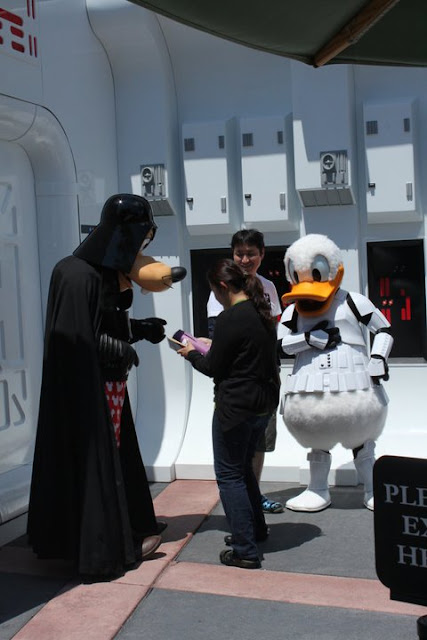
Here’s my prediction: There will be three new Star Wars movies. They will not be as good as the ones we saw as kids. That’s not really possible because those movies aren’t as good as the ones we saw as kids anymore either. (Looking at you, George.)
Because Disney is pretty good at franchise management, they will more than likely be competently written and directed. They will at least have dialogue that doesn't make your hair melt. They will have stories that kinda, sorta make sense. They might even be quotable. They will sell lots of new toys and there will be more rides at the theme parks.
We will survive. So will Star Wars.
We will probably pay our money to go see them for the novelty of seeing well-written, competently-directed Star Wars movies in the modern era. Lucas will finally have to stop screwing around with (and screwing up) the old movies. If nothing else, and if only because the Mouse never turned down a chance to sell us something, wewill probably finally get to see the original theatrical releases on Blue Ray might finally see a re-release of the original theatrical movies on Blue Ray (if they can negotiate a deal with Fox, which holds the distribution rights in perpetuity).
In all, it sounds like a good thing to me.
But now there will be Mickey-themed Star Wars everything!
I took this photo two years ago. Your argument is invalid.

Here’s my prediction: There will be three new Star Wars movies. They will not be as good as the ones we saw as kids. That’s not really possible because those movies aren’t as good as the ones we saw as kids anymore either. (Looking at you, George.)
Because Disney is pretty good at franchise management, they will more than likely be competently written and directed. They will at least have dialogue that doesn't make your hair melt. They will have stories that kinda, sorta make sense. They might even be quotable. They will sell lots of new toys and there will be more rides at the theme parks.
We will survive. So will Star Wars.
We will probably pay our money to go see them for the novelty of seeing well-written, competently-directed Star Wars movies in the modern era. Lucas will finally have to stop screwing around with (and screwing up) the old movies. If nothing else, and if only because the Mouse never turned down a chance to sell us something, we
In all, it sounds like a good thing to me.
In the meantime, there was this a hurricane that came ashore and punched in America's most populous region in the teeth. People are homeless, cold, and it will take time and money and a national effort to clean up and recover.
The people of the East Coast don't need our tweets as much as our more concrete efforts to help. Here is an excellent list of organizations that are already on the ground in the hurricane zone, helping our fellow countrymen put the pieces back together.
How about we release some pent-up some nerd energy in that direction...
Sandy's Aftermath: How You Can Help(via NBC news)
The people of the East Coast don't need our tweets as much as our more concrete efforts to help. Here is an excellent list of organizations that are already on the ground in the hurricane zone, helping our fellow countrymen put the pieces back together.
How about we release some pent-up some nerd energy in that direction...
Sandy's Aftermath: How You Can Help(via NBC news)
Friday, October 26, 2012
10 Tips to Get from Idea to Finished Novel (updated): NaNoWriMo
Labels:
Lists,
NaNoWriMo,
Writing Tips
For all those who are warming up to run the NaNoWriMo marathon, here's my annual list of 10 things that I personally try to keep in mind as I turn the idea I scribbled on a napkin into that thing we call a book.

There are ten of them, which makes a handy size for a list.
Writing is hard. Breathing life into the inanimate is supposed to be hard. Don't beat yourself up when you find that it isn't easy.
Ten Tips to Get From Idea to Finished Novel
1. Be interested in your story.
1. Be interested in your story.
Writing a novel is a relationship between you and a story. Before you spend hundreds of hours sitting in a chair stringing words together to tell that story, you'd better darn well be sure it's worth the commitment or it will all end in tears.
2. Feed your brain.
Your brain generates stories from the stuff you cram in there. Give it the fodder it needs to make new and interesting stories and well fleshed-out characters. Ask questions. Pay attention to the world around you. Everything is research. Pay attention. Take notes and snapshots. You never know when you'll need that story about the kid who accidentally ordered a Harrier fighter jet on eBay, or the chap that put lasers on sharks just to prove he could.
3. Ideas are not sacred.
Don't get so attached to an idea that you're unwilling to allow it to evolve. A story idea is less like the directions from a GPS and more like finding your way through a new city with written directions scrawled on the back of a coffee-stained napkin.4. Write now; edit later.
On the first draft, it's your job to put your butt in the chair and put the story on the page. The chair is the only part that's optional. Editing is inevitable, but it is a stage of its own that can wait until later. Your initial goal is to get the story out of your head; everything else follows that.
5. Take small bites.
A big idea can choke you if you try to eat it all at once. A big idea can choke you if you try to eat it all at once. Writing anything that's as large and complex as the average novel is a lot like the old adage about eating an elephant: Start at one end and take it one bite at a time.6. Make stuff up.
Research can be an addictive drug. It's easy to get so wrapped up in the intriguing minutiae of your subject matter that you forget to write a book about it. If it ever gets shelved in a library or bookstore, your novel will be in the fiction section, this gives you license to fake it... within reason, of course.
7. Be a story hoarder.
Never throw anything away. Not everything you create while writing will fit the story you're working on. Hang on to those tidbits and trimmings for later use in this or another story. Some of my favorite odd moments become short stories, the rest go back in the hopper for the next go-round.
8. Step away from the television and/or the Internet.
That might sound odd coming from me, but these mediums are specifically designed to catch your attention and hold it. I've recently begun doing my writing on a computer that is isolated from the internet to combat this. My writing output tripled when we got rid of TV and as a bonus we saved a lot of money each month.9. Use your own words.
Write with the vocabulary you have. Put away the thesaurus, it's just slowing you down and making you feel self-conscious. Finding your authorial "voice" is about telling the story the way you tell it, not the way Roget would tell it. Let your vocabulary grow organically on its own and in a way that is unique to you as you research and read. Language is a fragile thing and it will break if you try to force it.
10. Finish.
Writing may make you a writer, but only finishing will make you a novelist. You have to finish the story, even if you have to keep writing into December and January. The inability to write a complete novel in a month doesn't make you a bad writer. Quite the contrary, in fact. 50,000 words isn't a complete novel anyway. An unfinished novel is worth its weight in paper. Keep going until you get to type "The End".
It pains me somewhat that I can't finish that list with the words "And it's as simple as that". It's not simple. It's work, this thing that we do. And if you learn nothing else from participating in NaNoWriMo, it should be that.
However you choose to proceed and whether you reach November 30th with 50,000 words in the kitty or not, you will have learned something, maybe even accomplished something. I will be here on the sidelines, waving a banner and cheering you on. Revel in the words you are putting on the page. Try something that scares you. Read the things being shared by your compatriots if you can find the time. Celebrate the writing. Have fun.
Just remember, the deadline is imaginary, the prizes are fake, but the book you are trying to write can be real.
Best of luck to you all!
-Scott
-Scott

Wednesday, October 24, 2012
Advice About Advice: Mind the expiration dates.
Labels:
Book Collecting,
Caveat,
Lists,
Reading Lists,
Writing Guides,
Writing Tips
Yes, I'm giving advice about advice again. The thunder of approaching typewriters heralds the word avalanche known as NaNoWriMo and the explosion of writing advice posts on every site that even pretends to cater to writers.
 I've been fighting a particularly nasty chest cold recently, so about all I've been up for is reading and sorting through the books on my shelves. The unfortunate fact is that my library has as many books stacked on the floors as it does on the shelves. Which means (gulp) culling the herd.*
I'm sorry, but some of you will just have to go. Don't worry, we'll find new homes for you in the country where you can gambol and play...
In case it hasn't become clear in the past, there are a lot of books on my shelves about the craft of writing and what purport to be maps showing shortcuts through the labyrinth of publishing. Some of them are timeless. Tomes of inspiration that will never die. However, many, if not most of them are well past their expiration date.
Some of them expired before they hit the shelf. It's just that kind of industry these days.
It seems that almost every author of note from Norman Mailer to Ray Bradbury to Stephen King, eventually writes a memoir of the craft, which tracks their rise from being 'That weird kid**' to a giant in a world of words. Nearly all of these books are split about evenly between memoir and advice for new writers.
We like to think that if we follow in the footsteps of the great and the good, that we too can apply their formula and achieve success. That's certainly the conceit of most writing guides. The problem is that the industry that spat out most of the greats either no longer exists or is teetering on the brink of extinction.
As I face the decision on which of these many books to keep and which to discard, in the end it will come down -- as it always does -- to the writing. Unless you have a time machine handy, business and publishing advice from even as late as the 1990's and early 00's is essentially useless. Only the writing advice is timeless.
This is a theme I return to time and again. Just the other day, I talked about how much I liked Neil Gaiman's list of writing rules because it focused almost entirely on the writing. In order to be a writer, Gaiman tells us, you have to write something, and you have to keep writing it until it's finished. This is important because that's the only advice that will outlast the expiration date of all other advice.
Unless it's also a compelling memoir and worth keeping for that fact alone, any writing guide that doesn't boil down to this very simple concept goes in the Goodwill pile.
----
* I would like to apologize in advance to anyone in the Puget Sound region who is startled by the whoop of joy originating from my wife's location wherever she happens to be when she reads that sentence.
** As much as I try to keep away from the idea that there's some sort of universal "writer lifestyle" that we all should aspire to, there's a nearly insurmountable pile of evidence that writers tend to arise from the ranks of "that weird kid".

I'm sorry, but some of you will just have to go. Don't worry, we'll find new homes for you in the country where you can gambol and play...
In case it hasn't become clear in the past, there are a lot of books on my shelves about the craft of writing and what purport to be maps showing shortcuts through the labyrinth of publishing. Some of them are timeless. Tomes of inspiration that will never die. However, many, if not most of them are well past their expiration date.
Some of them expired before they hit the shelf. It's just that kind of industry these days.
It seems that almost every author of note from Norman Mailer to Ray Bradbury to Stephen King, eventually writes a memoir of the craft, which tracks their rise from being 'That weird kid**' to a giant in a world of words. Nearly all of these books are split about evenly between memoir and advice for new writers.
We like to think that if we follow in the footsteps of the great and the good, that we too can apply their formula and achieve success. That's certainly the conceit of most writing guides. The problem is that the industry that spat out most of the greats either no longer exists or is teetering on the brink of extinction.
As I face the decision on which of these many books to keep and which to discard, in the end it will come down -- as it always does -- to the writing. Unless you have a time machine handy, business and publishing advice from even as late as the 1990's and early 00's is essentially useless. Only the writing advice is timeless.
This is a theme I return to time and again. Just the other day, I talked about how much I liked Neil Gaiman's list of writing rules because it focused almost entirely on the writing. In order to be a writer, Gaiman tells us, you have to write something, and you have to keep writing it until it's finished. This is important because that's the only advice that will outlast the expiration date of all other advice.
Unless it's also a compelling memoir and worth keeping for that fact alone, any writing guide that doesn't boil down to this very simple concept goes in the Goodwill pile.
----
* I would like to apologize in advance to anyone in the Puget Sound region who is startled by the whoop of joy originating from my wife's location wherever she happens to be when she reads that sentence.
** As much as I try to keep away from the idea that there's some sort of universal "writer lifestyle" that we all should aspire to, there's a nearly insurmountable pile of evidence that writers tend to arise from the ranks of "that weird kid".
Wednesday, October 17, 2012
This is not a drill: A Nano-Memo from the Secretary
Labels:
Humor,
NaNoWriMo,
Writing Tips
|
| For unofficial use only. |
Open Memo from the Department of Literary Security
To: All Departments & Interested Parties
RE: Literary Alert Level Tango
We have been monitoring internet traffic on sites frequented by wordsmiths, and literary agents provacateurs from the Office of Letters & Light and are reporting an uptick in chatter related to writing nonstop for a month and the hoarding of items related to same.
We can only conclude that a Significant Word-Count Event (SWCE) is imminent.
Pending a presidential declaration of a state of emergency (The White House and FEMA is not returning our calls as of this writing) all writers are advised to shelter in place or seek out the nearest library or coffee shop.
During the last SWCE, over 3 billion words erupted from the nation's writers and worldwide shortages of coffee, pastries, and adjectives were reported.
This is not a drill.
During moments of extreme literary unrest, the department advises that it can take up to thirty (30) days for emergency supplies to reach affected areas. All writers are advised to stock up on necessary supplies and foodstuffs sufficient to sustain life and word counts unaided for thirty (30) days without resupply.
Our experts have prepared the following list of suggested supplies for all writers:
- A comfy place to sit or stand in a place conducive to surviving 30 unbroken days of writing.
- Coffee, tea, hot cocoa, or coffee.
- Sustainable levels of baked goods.
- Vegetables for when you are feeling guilty for trying to survive entirely on items 2 and 3.
- Writing implements to fit your age, milieu, or chosen level of pretense.
- Ink for pens, printers, copiers, goose quills (see item #5).
- Phone numbers of out-of-area contacts willing to take late-night phone calls when you are stuck, overwhelmed, or procrastinating.
- A padlock to secure the off-switch for the internet for most of the duration of the emergency.
- A supportive and/or tolerant spouse, family member, roommate, significant other, good friend, complete stranger you thought you knew but turned out you didn't but who gives surprisingly good advice on dialogue.
- A sense of humor.
Additional items, medications, &c. may be added as needed for the individual. Good luck and may the spirit of those who came before guide you in this time of trial.
The department will monitor the situation and report developments via the usual channels as events warrant.
See you in December.
Regards, etc.
Scott W. Perkins
Secretary of Literary Security
(Presidential appointment and congressional confirmation pending)

Subscribe to:
Posts (Atom)